Guide · Strings
String sizing: Voc in the cold, Vmp in the heat.
A string has to stay below the inverter’s maximum voltage on the coldest morning and above the lower limit of the MPPT window on the hottest day. Here is how to work out the longest and shortest string and check the current per MPPT.
Updated
Why the cold sets the string length
The open-circuit voltage of a solar cell rises as the cell gets colder. The highest voltage in a string therefore occurs on a cold, clear morning just after sunrise, before the inverter has started operating: the panels are cold and the string is unloaded. That voltage must not exceed the inverter’s maximum permitted DC voltage, nor the panel’s maximum system voltage.
In the other direction, the voltage at maximum power (Vmp) falls as the panels heat up. On a hot summer day a short string can drop below the lower limit of the MPPT window. The inverter can then no longer track the panels’ maximum power point and output falls – just when the sun is strongest. This is a question of yield, not of safety.
Longest string
n_max = ⌊ U_DC,max / ( Voc × (1 + β/100 × (T_min − 25)) ) ⌋- Voc: the panel’s open-circuit voltage at standard test conditions (STC, 25 °C cell temperature), from the datasheet.
- β: the temperature coefficient of Voc in per cent per degree. It is negative, for example −0.23 %/°C, so the bracket is greater than 1 when T_min is below 25 °C.
- T_min: the lowest cell temperature you allow for on site.
- U_DC,max: the inverter’s maximum permitted DC voltage. Check the same string voltage against the panel’s maximum system voltage.
- ⌊ ⌋ means rounding down.
Shortest string
n_min = ⌈ U_MPPT,min / ( Vmp × (1 + γ/100 × (T_max − 25)) ) ⌉- Vmp: the voltage at maximum power at STC, from the datasheet.
- γ: the temperature coefficient of Vmp. Many datasheets give only the coefficients for Isc, Voc and Pmax, in which case the Pmax coefficient is used. It is an approximation: the current rises slightly with temperature, so Vmp falls a little more than the power. Leave a small margin to the lower limit for that reason.
- T_max: the highest cell temperature you allow for. 70 °C is a common value for roof-mounted panels.
- U_MPPT,min: the lower limit of the MPPT window. Some datasheets give both the window at rated power and a lower voltage at which the MPPT still operates. The lower value gives the shortest string that works; the higher one gives full power.
- ⌈ ⌉ means rounding up.
Worked example: LONGi Hi-MO 6 and SMA Sunny Tripower 10.0
- Panel
- LONGi LR5-54HTB-440M: Voc 39.83 V, Vmp 33.56 V, Isc 14.15 A, Imp 13.12 A, β −0.230 %/°C, Pmax coefficient −0.290 %/°C
- Inverter
- SMA Sunny Tripower 10.0 (STP10.0-3AV-40): max. 1,000 V DC, MPP range 320–800 V, input A two strings (Isc max. 30 A, usable current 20 A), input B one string (Isc max. 18 A, usable current 12 A)
- Voc at −25 °C
- 39.83 × (1 + (−0.0023) × (−50)) = 39.83 × 1.115 = 44.41 V
- Longest string at −25 °C
- 1,000 / 44.41 = 22.5 → 22 panels (977 V)
- Longest string at −10 °C
- 39.83 × 1.0805 = 43.04 V → 1,000 / 43.04 = 23.2 → 23 panels (990 V)
- Vmp at 70 °C
- 33.56 × (1 + (−0.0029) × 45) = 29.18 V
- Shortest string
- 320 / 29.18 = 10.97 → 11 panels (321 V)
- Vmp at −25 °C against the upper limit of the window
- 33.56 × 1.145 = 38.43 V → at most 20 panels below 800 V (769 V)
- Current on input A, two strings
- Isc 2 × 14.15 = 28.3 A against the 30 A limit. Operating current 2 × 13.12 = 26.2 A against the usable 20 A.
At −25 °C the string is 11–22 panels, or 11–20 if Vmp is to stay within the MPP range on a cold day as well. Calculating with −10 °C allows 23 panels: the same panel and inverter, one panel longer. Input A can take two parallel strings on short-circuit current, but the inverter limits the operating current to 20 A, so some power is lost in full sun. On input B, a single string is already above the usable current of 12 A.
The current per MPPT
The short-circuit current is the hard limit. The sum of Isc for the strings connected in parallel on one MPPT must not exceed the input’s maximum short-circuit current in the datasheet. The datasheet also says how many strings each input takes, and the inputs can differ.
The maximum usable input current is a separate limit. If the operating current is above it, the inverter limits the current and shifts the operating point. The result is lower output when the sun is high, not a fault. High-current panels, like the one in the example, can exceed the limit with a single string.
Only connect strings of the same length and the same roof orientation to one MPPT. Parallel strings share the same voltage, so a shorter string, or one facing another way, pulls the other away from its maximum power point.
Margins to allow for
- The datasheet tolerance. LONGi states ±3% on Voc and Isc for the panel in the example. If the string is close to the limit, allow for it.
- The temperature is the cell temperature. At dawn, before the sun has warmed the panels, the cell is close to the air temperature. Start from the lowest temperature on site, not from a winter average.
- Optimisers and microinverters have their own rules for string length and voltage. Follow the manufacturer’s instructions for the system.
The procedure
Get the datasheets
The panel’s Voc, Vmp, Isc, Imp and temperature coefficients. The inverter’s maximum DC voltage, MPPT window, strings per input, maximum short-circuit current and usable current per input.
Choose the temperatures
The lowest cell temperature for the site and the highest cell temperature for the mounting.
Calculate the longest string
Calculate Voc at the lowest temperature, divide the inverter’s maximum DC voltage by it and round down. Check the string voltage against the panel’s system voltage.
Calculate the shortest string
Calculate Vmp at the highest temperature, divide the lower limit of the MPPT window by it and round up.
Check the upper limit of the window
Vmp at the lowest temperature should stay below the upper limit of the MPPT window. Otherwise output is limited on cold, clear days.
Check the current
Isc times the number of parallel strings against the input’s limit, and the operating current against the maximum usable current.
Distribute the strings
One roof orientation per MPPT, and strings of equal length on the same MPPT.
How Ritwerk calculates it
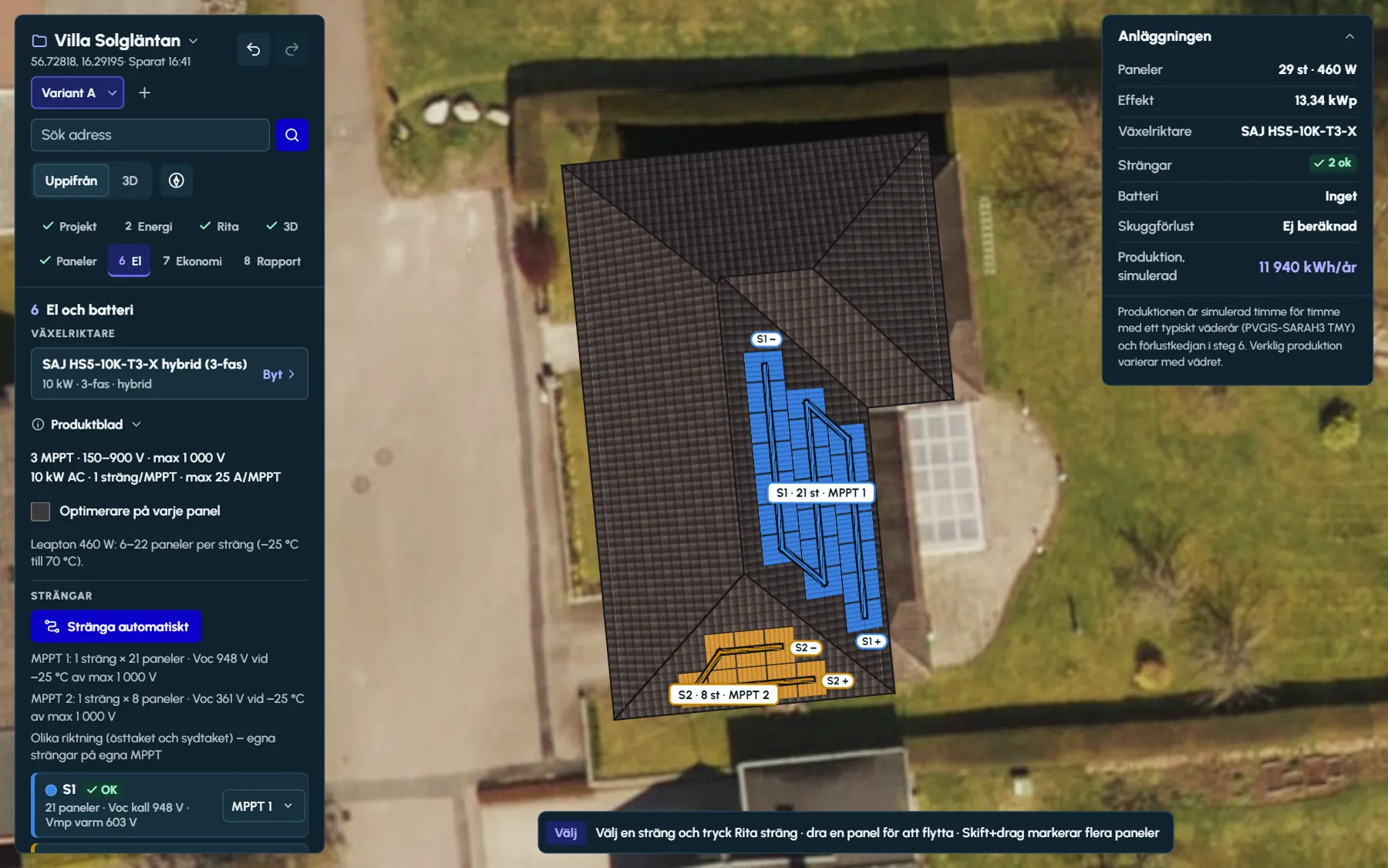
In step 6, Electrics and battery, you choose the inverter and see the range for the panel straight away – 11–22 panels per string for the example above. Ritwerk calculates Voc at −25 °C and Vmp at 70 °C cell temperature, with the coefficients from the product register and Vmp from the Pmax coefficient.
String automatically chooses strings as long as the limits allow. Without optimisers, it also keeps Vmp at −25 °C below the upper limit of the MPPT window, and the short-circuit current and number of strings per MPPT within the datasheet values. Below the button there is one line per MPPT with the string’s Voc against the inverter’s limit.
Each string in the list shows its panel count, cold Voc and hot Vmp, with OK or the error in plain language. The temperatures −25 °C and 70 °C are fixed in the designer. If you work with a different temperature for the site, do that check yourself with the formulas above.
In different countries
The basis is the same across Europe: CENELEC’s HD 60364-7-712:2016 on PV installations, with a normative Annex B on how the maximum open-circuit voltage (UOC MAX) and the maximum short-circuit current (ISC MAX) are determined. CENELEC’s member countries adopt it in their own installation rules. The international original, IEC 60364-7-712, came out in a new edition in 2025. The lowest temperature is chosen for the site; the national practice we have been able to verify is set out below.
Sweden: section 712 of SS 436 40 00:2023 (edition 4), the electrical installation rules from SEK Svensk Elstandard. We have not found a national standard temperature for the Voc calculation. Winters differ a great deal between the south and the north of the country, so start from the lowest local temperature and check that −25 °C is enough where you are building.
Germany: DIN VDE 0100-712:2016-10, the German edition of HD 60364-7-712:2016. SMA’s technical information on system design uses an outdoor temperature of −10 °C for systems in Germany as its example and marks −10 °C and +70 °C cell temperature as the usual design range, noting that the mounting and the local temperature have to be taken into account.
Spain: the low-voltage regulations REBT (Real Decreto 842/2002), in which ITC-BT-40 covers low-voltage generating installations. Under CENELEC rules, HD 60364-7-712 is to be adopted in Spain as well. We have not found an official standard temperature. The difference between the coast and the inland plateau is large, so start from the lowest local temperature.
Italy: CEI 64-8 part 7-712 for the installation, and CEI guide 82-25 for the design, construction and operation of PV systems. In Italian design documents, −10 °C and 70 °C are common check points: Voc at −10 °C against the maximum voltage of the inverter and the panel, Vmp at 70 °C against the lower limit of the MPPT window. That is practice; in mountain areas the lowest local temperature can be lower.
Sources
- LONGi, datasheet LR5-54HTB 440–450M (20230811V19) – checked 14 November 2026
- SMA, datasheet Sunny Tripower 8.0–10.0 (STP8-10-3AV-40-DS-en-41) – checked 14 November 2026
- HD 60364-7-712:2016, foreword and table of contents (Annex B: calculation of UOC MAX and ISC MAX) – checked 14 November 2026
- IEC 60364-7-712:2017, superseded by IEC 60364-7-712:2025 (NSAI Standards) – checked 14 November 2026
- VDE Verlag, DIN VDE 0100-712 (VDE 0100-712):2016-10 – checked 14 November 2026
- SIS, SS 436 40 00:2023 edition 4 – checked 14 November 2026
- SMA, Technical Information: Designing PV Plants Optimised for Economic Efficiency (PV-Ausl-TI-en-10) – checked 14 November 2026
- CEI, Progetto CEI 82-25/3 (PRJ-3560), referring to CEI 64-8/7-712 – checked 14 November 2026
- Comune di Rimini, relazione tecnica fotovoltaico (check at −10 °C and 70 °C), 2021 – checked 14 November 2026
- BOE, Real Decreto 842/2002, Reglamento electrotécnico para baja tensión – checked 14 November 2026
Questions and answers
Questions and answers
At what temperature should I calculate Voc?
At the lowest cell temperature that can be expected on site. At dawn, when the string is unloaded, the cell is close to the air temperature. In Germany and Italy many designers use −10 °C. Ritwerk calculates with −25 °C, which gives a string one panel shorter in the example above.
Why is Vmp calculated with the power temperature coefficient?
Many datasheets give temperature coefficients for Isc, Voc and Pmax but not for Vmp. The Pmax coefficient is an approximation. Because the current rises slightly with temperature, Vmp falls a little more than the power, so leave a small margin to the lower limit of the MPPT window.
What happens if the string falls below the MPPT window?
The inverter cannot track the panels’ maximum power point and output falls. Below the inverter’s minimum input voltage it feeds in nothing at all. It is a question of yield, not of safety, but it costs energy on the hottest, sunniest days.
Can strings of different lengths share an MPPT?
Parallel strings on the same MPPT share the same voltage. If they are different lengths, at least one of them operates away from its maximum power point. Put strings of different lengths, and strings on different roof orientations, on separate MPPTs. With optimisers, the manufacturer’s rules apply.
Is it enough to check the short-circuit current?
The short-circuit current is the safety limit for the input. Also check the maximum usable input current. If the operating current is above it, the inverter limits the current, and some power is lost in full sun.
Read next
- String designVoc at −25 °C, Vmp at 70 °C, current per MPPT – and the longest strings the limits allow.
- Component library570 products with search by power, favourites, product sheets and a link to the manufacturer’s datasheet.
- Shading losses on solar panelsNear shading, horizon and rows – and why a partly shaded panel loses more than its share.
Try it on a real roof.
The designer opens in your browser, with no account. Search for an address and start drawing.