Feature · Products
Panels, inverters and batteries in one register.
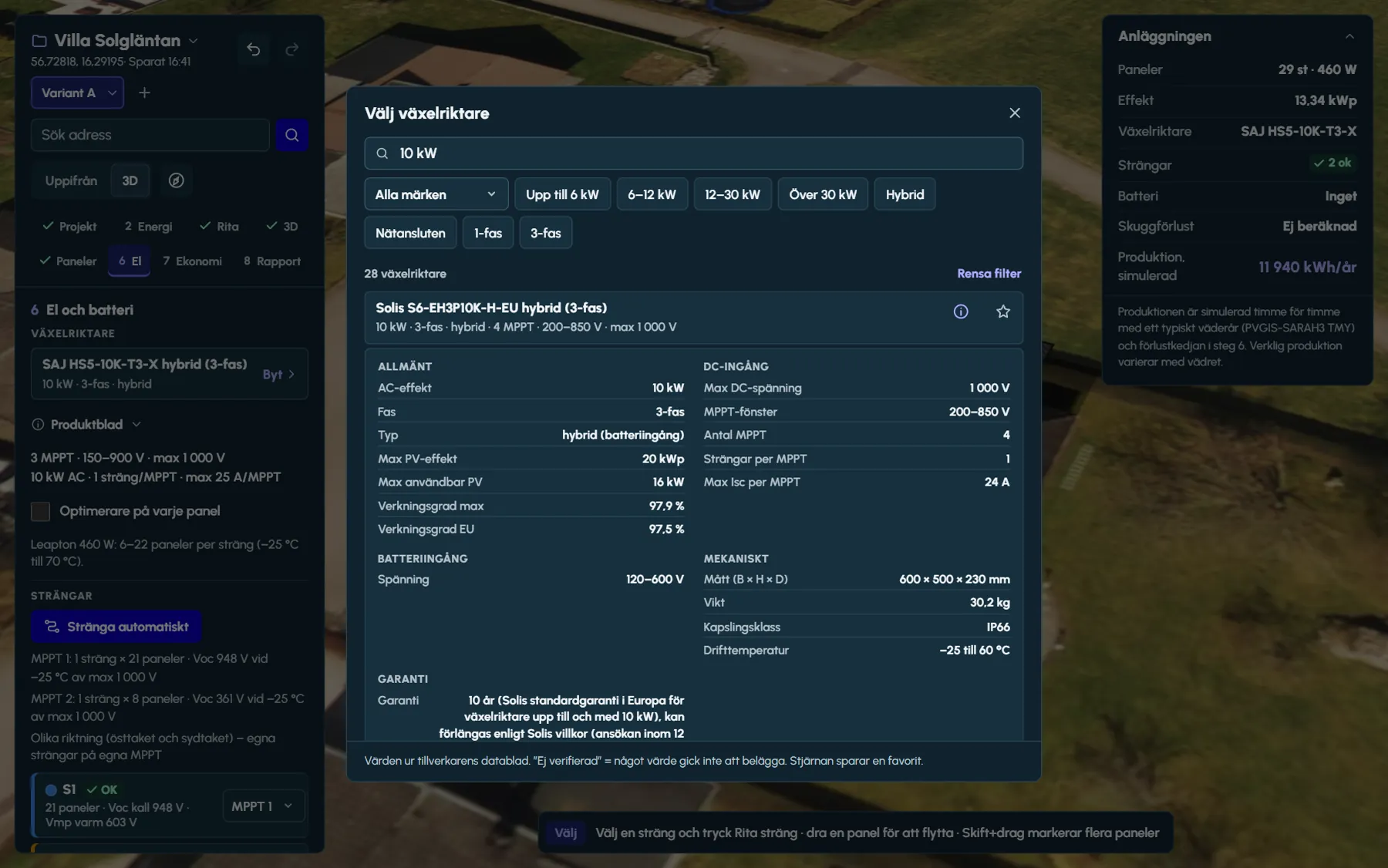
Search by brand, model or power, filter and expand the product sheet without leaving the designer. Favourites and recently used products are at the top.
In the register
- 120
- panel models
- 415
- inverters
- 35
- batteries
Search the way you say it
The search reads brand, model, series and power. A number with a unit counts as a word of its own, so "10 kW" finds ten-kilowatt inverters but not 110 kW, and "5 kW" does not find 12.5 kW. A decimal comma works too, and type designations can be searched in parts: "10k" finds the Solis S6-EH3P10K.
Each product appears once in the list, sorted into groups: your own panels in the project, favourites, recently used and then all. The number of hits is shown at the top, and Clear filters removes the search and the filters in one go.
Filters per product type
- Panels: brand, power (under 450 W, 450–499 W, 500 W and up), all-black and bifacial
- Inverters: brand, hybrid or grid-tied, single- or three-phase and power (up to 6 kW, 6–12 kW, 12–30 kW, over 30 kW)
- Batteries: brand, high or low voltage and size (up to 10 kWh, 10–20 kWh, over 20 kWh)
What each row shows
- Panel: power, dimensions, efficiency, colour and whether it is bifacial
- Inverter: AC power, phases, hybrid or grid-tied, number of MPPTs, MPPT window and maximum DC voltage – and whether it needs an optimiser on every panel
- Battery: kWh per module, size from the smallest to the largest number of modules, high or low voltage and the inverters the manufacturer lists
- A panel whose datasheet lacks a value the designer needs, such as dimensions or a temperature coefficient, opens the Own panel form with the values that are available, so you can complete it
The product sheet
The (i) button on a row expands the product sheet below the row, and the same sheet is shown under the selected product in the step. The sheet shows only the values that are available, each with its unit.
For a panel: power, efficiency, Voc, Vmp, Isc and Imp at STC, maximum system voltage, the temperature coefficients of Voc, Pmax and Isc, dimensions, weight, cell type and warranties. For an inverter: AC power, phases, hybrid or grid-tied, maximum DC voltage, start-up voltage, MPPT window, number of MPPTs, strings and current per MPPT, battery input, dimensions, weight, IP rating, operating temperature and warranty. For a battery: kWh per module, number of modules, power, depth of discharge, voltage, chemistry, dimensions, weight and the inverters the manufacturer lists as compatible.
At the end of the sheet are the link to the manufacturer’s datasheet and the datasheet version, and the warranty terms where available. A product with a value that could not be verified is marked unverified.
Batteries that pair with the inverter
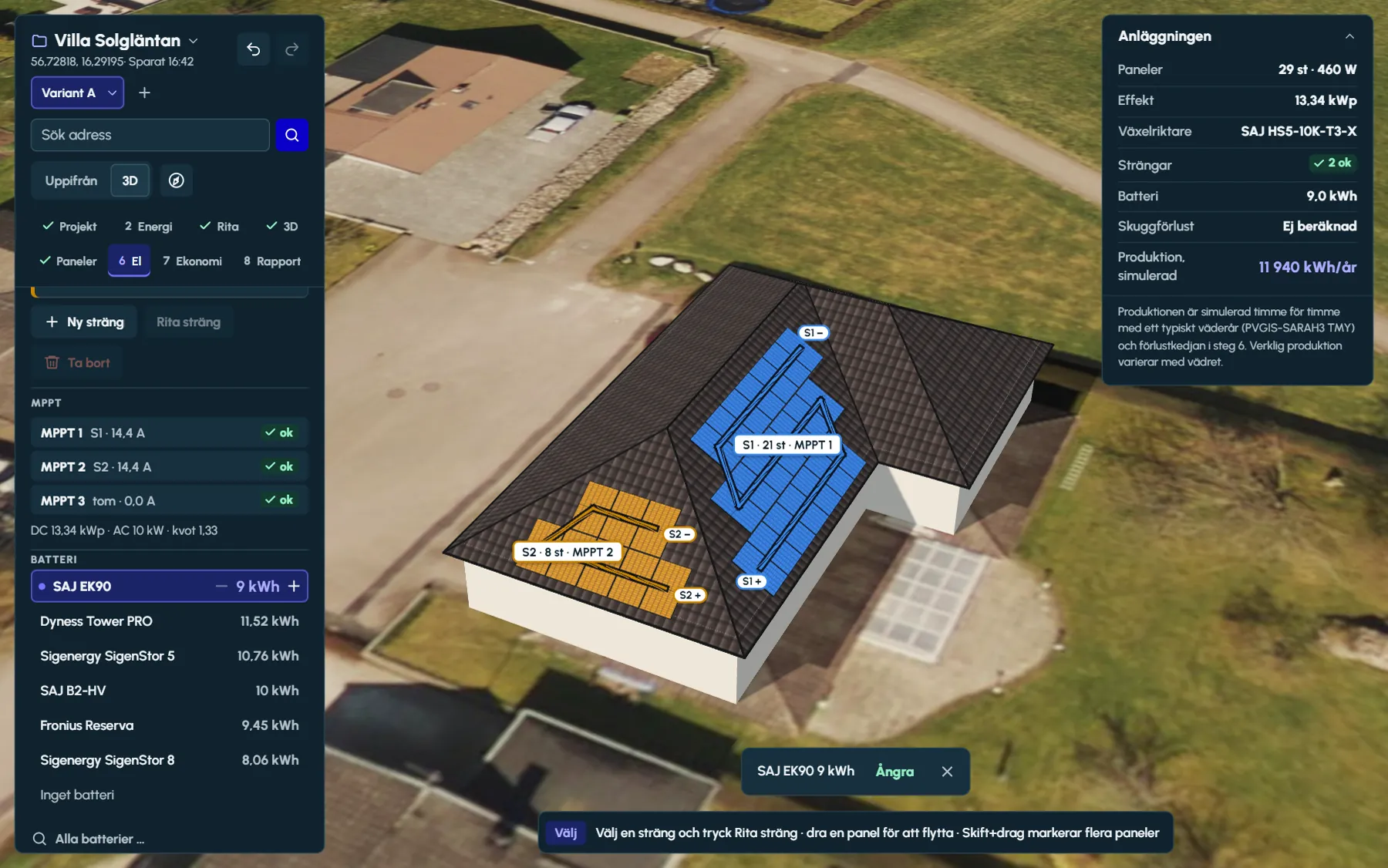
In step 6 the battery list shows the batteries that work with the selected inverter. All batteries … opens the whole register with the same search, filters and product sheets. A selected battery gets the smallest number of modules the inverter’s battery input accepts.
The inverter is chosen in the same box, and its MPPT window, strings per MPPT and current per input are what the string design is then checked against.
Favourites, recently used and the keyboard
The star on a row makes the product a favourite. Favourites and the eight most recently used items per product type sit at the top of the list and are kept in the browser for your next visit.
The whole picker works from the keyboard: arrow down from the search field into the list, arrows between rows, F for favourite, I for the product sheet, Enter to select and Esc to close. A selection is one step that can be undone.
Own panel
If a panel is missing, you add it from its datasheet: name, brand, power, length and width in millimetres, Voc, Isc, Vmp, Imp and the three temperature coefficients, plus the weight if you like. The values are checked before the panel is saved; it then sits at the top among your own panels in the project and is kept when the project is saved.
Questions and answers
Questions and answers
Which brands are in the register?
Among the inverters: Deye, Fronius, GoodWe, Growatt, Huawei, SAJ, Sigenergy, SMA, SolarEdge, Solis, Sungrow and Victron Energy. Among the batteries: BYD, Deye, Dyness, GoodWe, Growatt, Huawei, Pylontech, Sigenergy, SMA, SolarEdge and Sungrow. Among the panels, AIKO, Canadian Solar, JA Solar, JinkoSolar, LONGi, REC, Trina Solar and Leapton, among others.
What do we do if a panel is missing?
Choose Own panel in the panel picker and type in the values from the datasheet: power, dimensions, Voc, Isc, Vmp, Imp and the temperature coefficients. The panel is saved in the project and can be selected like the others.
Where does the product data come from?
From the manufacturers’ datasheets. The product sheet links to the datasheet and gives its version, and a product with a value that could not be verified is marked unverified.
Does a search for "10 kW" also find 110 kW?
No. A number with a unit is searched as a word of its own, so "10 kW" only finds ten kilowatts and "5 kW" does not find 12.5 kW. A decimal comma works too, and "10k" finds type designations such as S6-EH3P10K.
Are favourites saved?
Yes, in the browser, per product type. Favourites and the eight most recently used panels, inverters and batteries are at the top of the list the next time the picker opens.
Read next
- String sizing and Voc in the coldThe most and fewest panels per string, worked out step by step with real datasheets.
- Battery sizing for solar PVSelf-consumption, hourly readings, the knee where the next kWh adds less, hourly prices and backup power.
- String designVoc at −25 °C, Vmp at 70 °C, current per MPPT – and the longest strings the limits allow.
- Ritwerk vs SolarEdge DesignerTwo web tools – one built for SolarEdge systems, the other independent of the manufacturers.
Try it on a real roof.
The designer opens in your browser, with no account. Search for an address and start drawing.