Solutions
One designer, four kinds of customer.
A house, a housing association, a warehouse and a farm each raise different questions. Here is how to draw and calculate each of them.
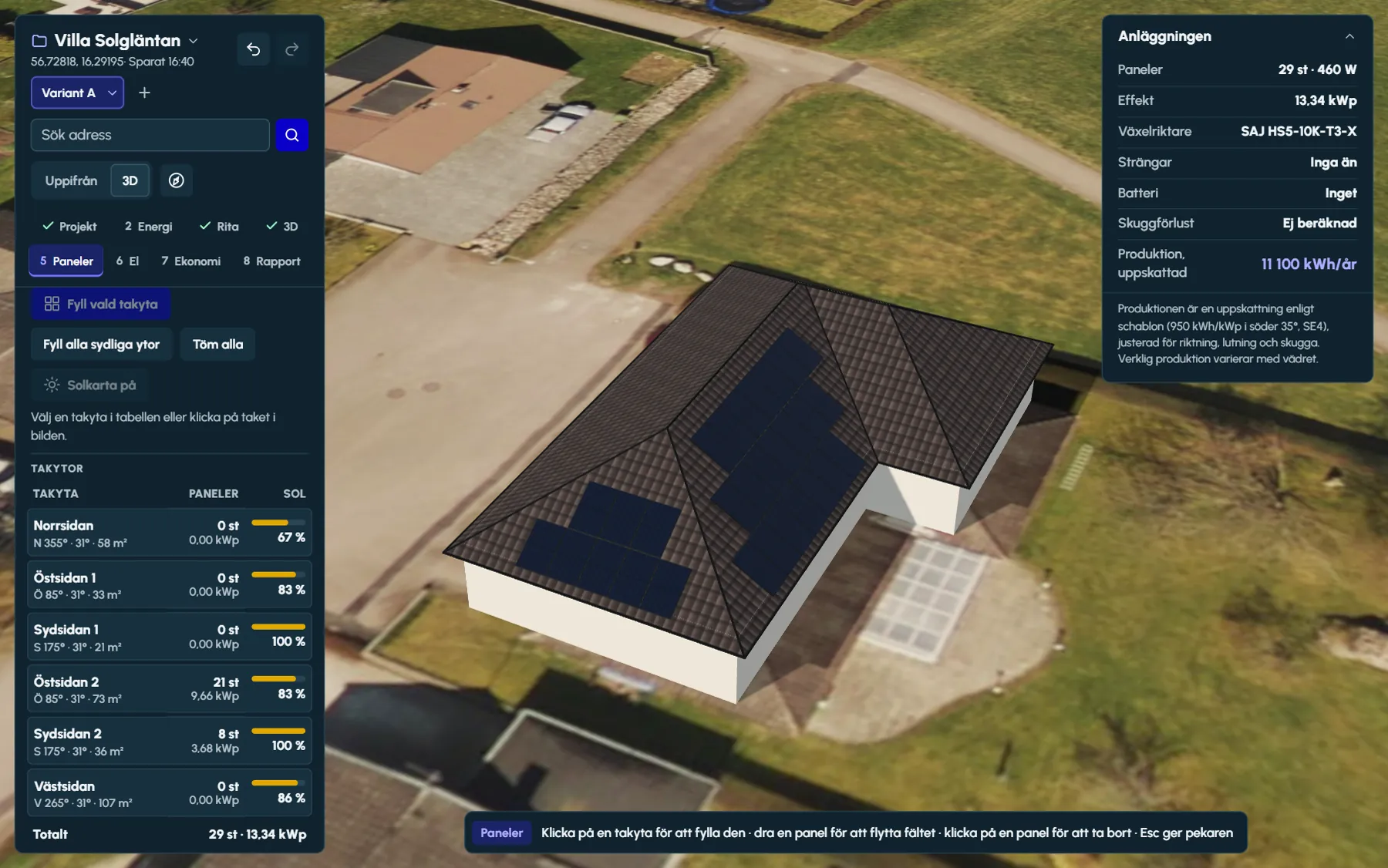 Solar PV for housesDormers, heat pump, EV and battery – the house roof and the household’s electricity calculated hour by hour, with a report for the household.
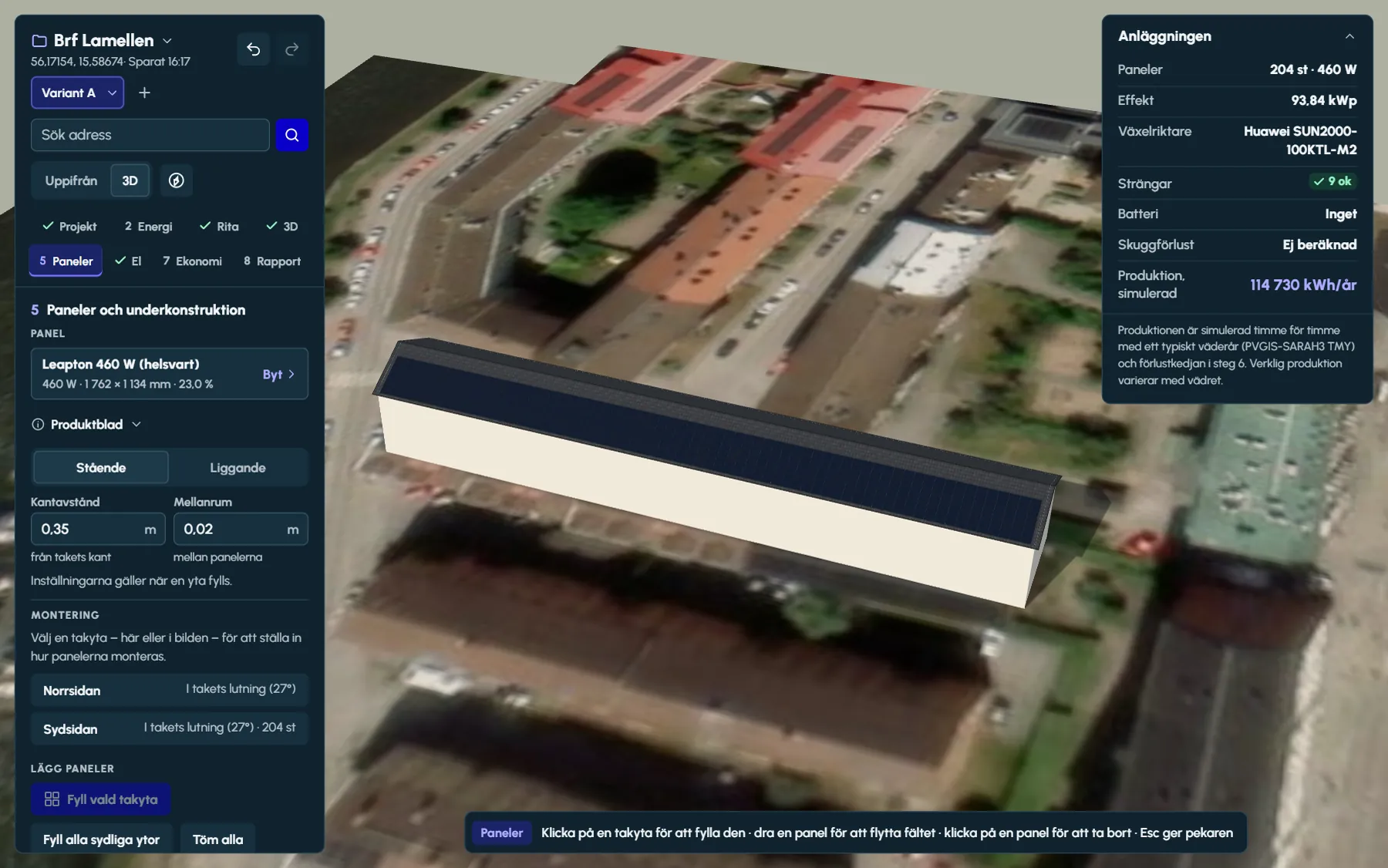 Solar PV for apartment buildingsSeveral building parts, the association’s hourly readings and variants side by side – the basis the board needs.
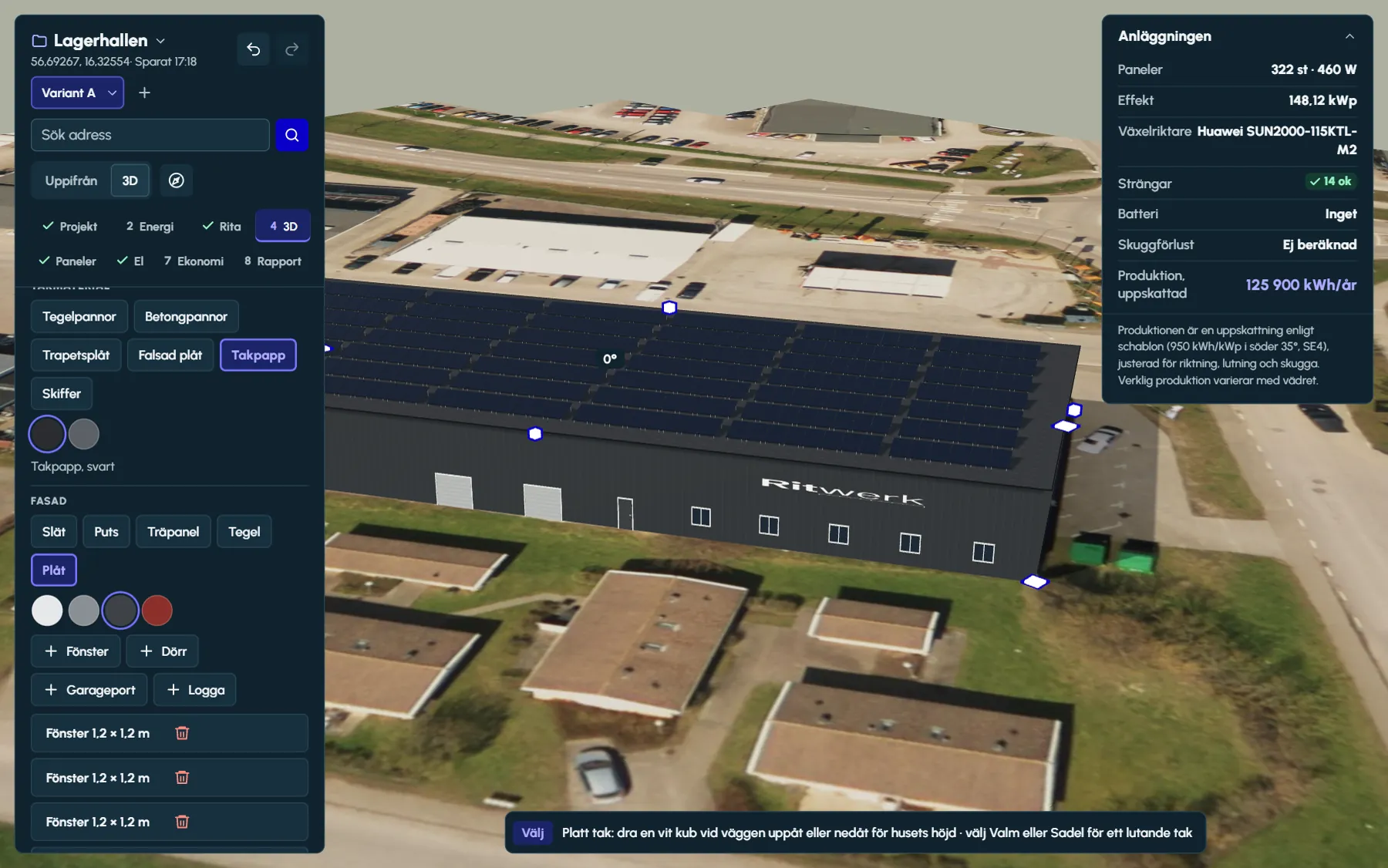 Solar PV on commercial roofsFlat roofs with east–west or south-facing rows, maintenance walkways, snow and wind loads and the customer’s logo on the facade.
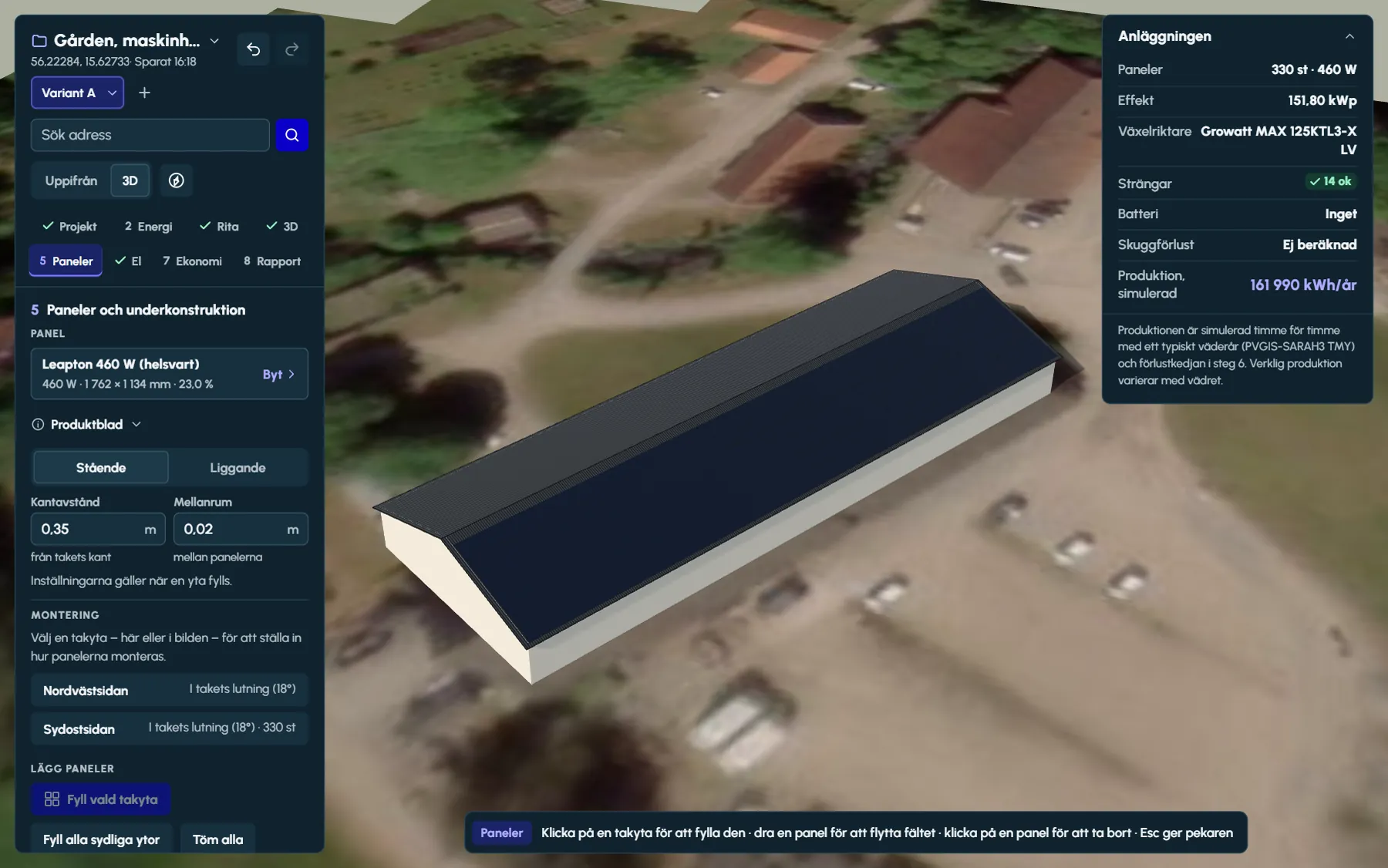 Solar PV for agricultureBarns and machinery sheds with large gable roofs, calculated against the farm’s own hourly readings.
Same eight steps, different questions
The workflow is the same for every customer: project, energy, draw, 3D, panels, electrics and battery, economics and report. What differs is what you choose in each step.
The roof decides the mounting: on pitched roofs the panels lie at the roof pitch, on flat roofs they stand on ballasted racks facing east–west or south. Consumption decides self-consumption: a profile for a house, a housing association or a business, or the customer’s own hourly readings. The customer type decides the VAT in the calculation.
Questions and answers
Questions and answers
What kinds of systems can be designed in Ritwerk?
Rooftop PV: houses, apartment buildings, commercial buildings and farm buildings. Pitched roofs are raised from the outline with Inner edges, and flat roofs get east–west or south-facing racks.
Which consumption profiles are available?
House (with the options heat pump and EV), housing association and business. If the customer has hourly readings from their grid operator, they are uploaded as CSV and used instead of the profile.
How does the calculation differ between private customers, housing associations and businesses?
Private customers and housing associations get the price including VAT, since they normally cannot reclaim it. Businesses get the price excluding VAT. The payback period is calculated on the price the customer pays.
Read next
Try it on a real roof.
The designer opens in your browser, with no account. Search for an address and start drawing.