Guide · Shading
Shading losses: why a little shade costs a lot.
A chimney, a dormer or a tree can cut the yield by more than the size of the shadow suggests. Here are the causes, how the loss is calculated and what the sun’s elevation means in different parts of Europe.
Updated
Three sources of shade
- Near shading: chimneys, dormers, ventilation cowls, aerials, trees and neighbouring buildings. The shadow moves across the roof during the day and shifts with the season.
- Horizon: hills, ridges and forest further away. It blocks the sun when it is low – morning, evening and winter – and affects the whole system roughly equally.
- Self-shading: on flat roofs and on the ground, one row of panels shades the next when the sun is low. The row spacing decides how often this happens.
Why a partly shaded panel loses more than its share
The cells in a panel are connected in series and share the same current. A shaded cell produces less current than the others, and without protection it is forced to carry the current in reverse. It then becomes a load that heats up – a so-called hot spot.
The bypass diode sits in parallel with a group of cells. When the group is reverse-biased, the diode carries the current past it, and the voltage across the shaded group is limited to roughly one diode drop. PVEducation gives about 15 silicon cells as an upper limit per diode, which is why a panel is divided into several substrings, each with its own diode.
The price is that the whole substring is bypassed. In a panel with three substrings, a shadow over just a few cells can take a third of the power, and a shadow across all three can take almost all of it.
In a string without optimisers, all panels share the same current. The inverter looks for the operating point that gives the most power for the whole string: either the string carries the weaker panel’s current, or that panel’s substrings are bypassed and the string voltage drops. The power curve gets several peaks, and the difference from the sum of the panels’ own maximum power is the mismatch loss.
Panel orientation relative to the shadow
In a typical panel with three substrings, they run along the long side. A shadow along the bottom edge of the panel – from the row in front on a flat roof, or from snow that stays put – therefore reaches all three substrings in a portrait panel but only the bottom one in a landscape panel. That is one reason to lay panels in landscape in rows. Check the number of bypass diodes and how the cells are connected in the panel datasheet.
Solar elevation at midday
h = 90° − φ + δ- φ: the latitude of the site. δ: the solar declination, from −23.44° at the winter solstice to +23.44° at the summer solstice.
- At the winter solstice, h = 90° − φ − 23.44°, the lowest midday solar elevation of the year (solar time).
- The length of the shadow on level ground is the object’s height divided by tan h.
In different countries: the winter sun and how much winter counts
| City | Latitude | Solar elevation at midday, 21 December | Shadow per metre of height | Share of annual yield Nov–Jan |
|---|---|---|---|---|
| Stockholm | 59.33° N | 7.2° | 7.9 m | 5.2 % |
| Munich | 48.14° N | 18.4° | 3.0 m | 13.3 % |
| Madrid | 40.42° N | 26.1° | 2.0 m | 19.2 % |
| Rome | 41.89° N | 24.7° | 2.2 m | 16.8 % |
Solar elevation = 90° − latitude − 23.44°. Shadow per metre = 1 / tan(solar elevation), on level ground. The share is calculated with PVGIS 5.3 (SARAH3) for 1 kWp, 35° tilt facing south and 14 % system losses, on 14 November 2026.
What it means for shading
Sweden: in Stockholm the sun stands just over 7° above the horizon at midday in December, so a one-metre chimney casts a shadow almost eight metres long. November–January gives only about 5 % of the annual yield, so the long winter shadows cost little energy. What decides the annual total is shading from March to October.
Germany: in Munich the solar elevation is 18° and November–January gives just over 13 % of the year. A shadow that reaches the panels only in winter shows up in the annual total.
Spain: in Madrid the sun stands 26° above the horizon and winter gives close to a fifth of the yield. Winter shading counts for more than in the north, while a row spacing calculated for the winter sun costs less roof area, because the shadow per metre is shorter.
Italy: in Rome the solar elevation is 25° and winter gives 17 %. The picture is similar to Madrid. In valleys and near mountains, the horizon often matters more than the solar elevation.
How the shading loss is calculated
The calculation follows the sun through the year. For each moment it determines whether direct light reaches a point on the panel or is blocked, and the loss is weighted by how much sunlight falls at that moment. A shadow on a December morning therefore counts for little, a shadow at midday in June for a lot.
Diffuse light comes from the whole sky. The sky view factor is the share of the sky that a point on the panel sees, weighted by the panel’s tilt. A dormer or an adjacent wall takes a piece of the sky even when it does not block the sun, and so also reduces the diffuse light.
The horizon is added as a profile around the site: when the sun is below the profile, direct light counts as blocked. PVGIS, the European Commission’s calculation tool, derives such a profile from a terrain model.
Finally, the string is calculated electrically. The shading on each substring gives the panel’s curve, and the string’s operating point decides how much is lost. That is the difference between a geometric shaded fraction and the real power loss.
Optimisers and microinverters
With an optimiser or a microinverter on each panel, every panel works at its own maximum power point. Mismatch between panels in a string is then reduced, but substrings within a shaded panel are still bypassed by the bypass diodes. The components have their own losses and their own cost, and the benefit depends on how often and how unevenly the panels are shaded. Calculate the yield with and without, and compare the difference with the extra cost.
Rules of thumb
- Assess shading over the year, not on a single day. Winter shading costs little in the north and more in the south (see the table).
- Put panels with different shading on different strings or different MPPTs, so that the shaded ones do not drag down the unshaded ones.
- A shadow from the row in front reaches every substring in a portrait panel but only one in a landscape panel.
- Recalculate the shading when panels are moved or obstacles are added.
How it works in Ritwerk
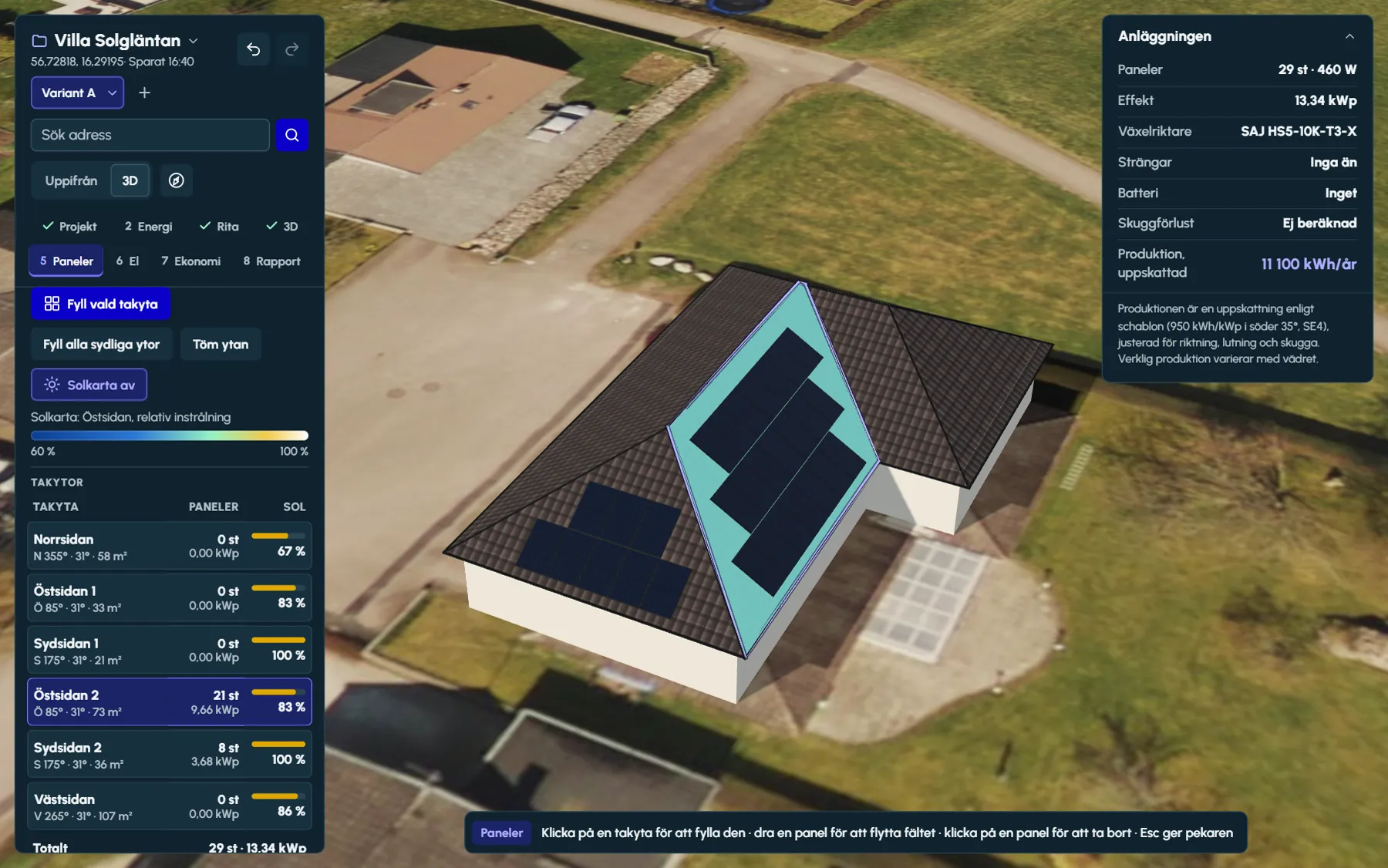
In step 5, the irradiance map shows the relative irradiance across a roof face in 25 cm cells, compared with an unshaded surface tilted 35° towards the south. Obstacles such as chimneys and dormers shade both the direct light and the sky, so the edge next to a dormer shows up as a change in colour.
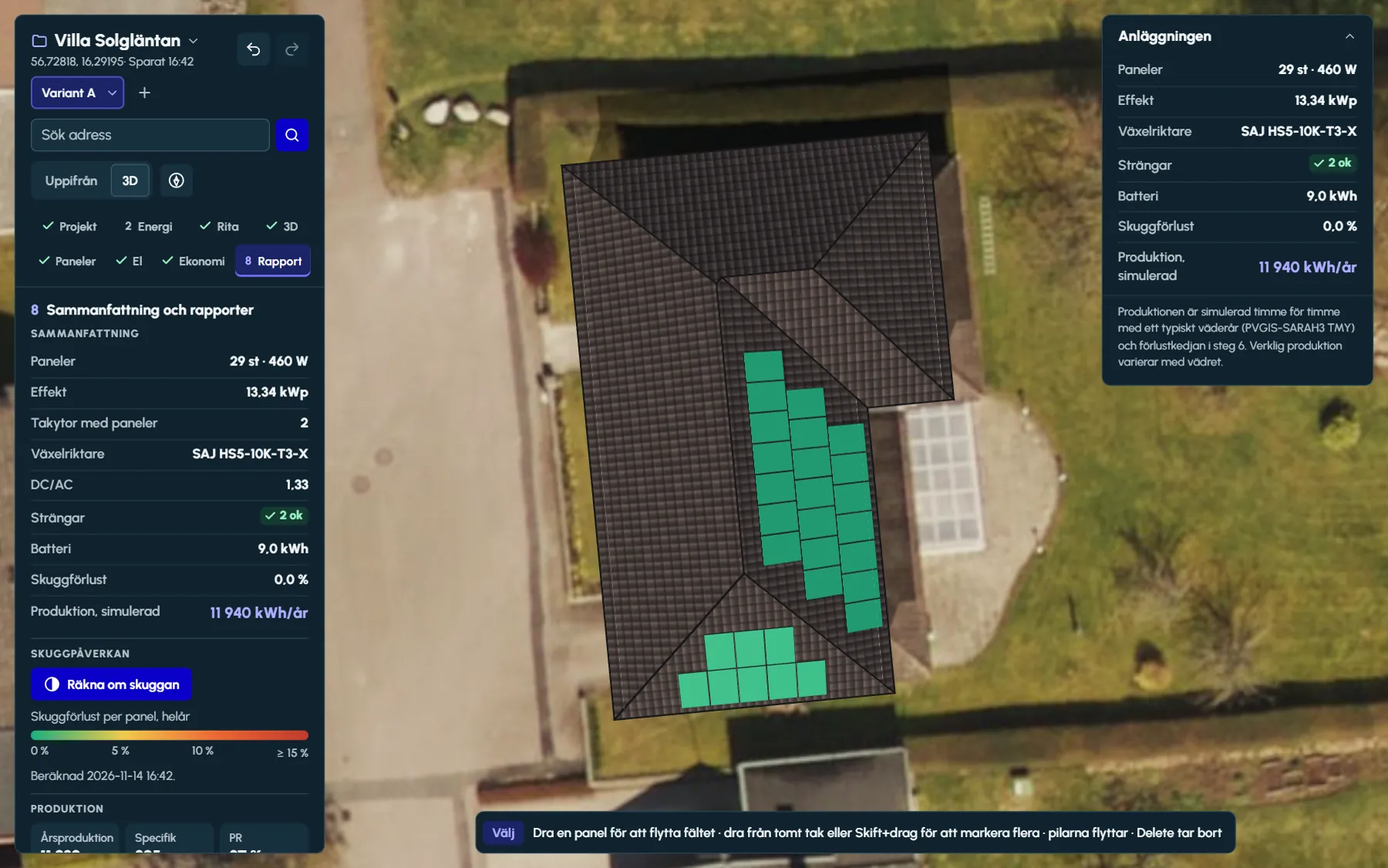
In step 8, Run shading analysis calculates the loss for every panel over the year: the sun’s path on the 21st of each month, every 30 minutes, with nine sample points per panel and the sky view for the diffuse light. The panels are coloured from 0 to 15 % and above, and the total loss for the system is shown.
The detailed simulation in the same step calculates the yield hour by hour with a typical weather year and the horizon from PVGIS. Shading is determined per panel, substring and hour, and the string’s power is calculated with bypass diodes and mismatch. With optimisers, each panel is calculated separately, with a one per cent loss in the optimiser.
Sources
- PVEducation, Elevation Angle (solar elevation at midday) – checked 14 November 2026
- PVEducation, Bypass Diodes (hot spot, about 15 cells per diode) – checked 14 November 2026
- PVGIS 5.3 PVcalc, Stockholm (59.33° N, 18.07° E) – checked 14 November 2026
- PVGIS 5.3 PVcalc, Munich (48.14° N, 11.58° E) – checked 14 November 2026
- PVGIS 5.3 PVcalc, Madrid (40.42° N, 3.70° W) – checked 14 November 2026
- PVGIS 5.3 PVcalc, Rome (41.89° N, 12.49° E) – checked 14 November 2026
Questions and answers
Questions and answers
How much does a partly shaded panel lose?
It depends on how the shadow falls across the panel’s substrings. A shadow within one of three substrings can take a third of the power, a shadow across all three almost everything. In a string without optimisers, the other panels in the string can lose output too, because they share current and operating point.
Why does winter shading matter less in Sweden?
Because winter gives little energy. According to PVGIS, November–January gives about 5 % of the annual yield in Stockholm, against 13 % in Munich and 19 % in Madrid, for the same south-facing panel. A long shadow in December therefore costs little in Sweden but more further south.
What is the sky view factor?
The sky view factor is the share of the sky that a point on the panel sees, weighted by the panel’s tilt. It determines how much diffuse light the panel receives. An adjacent wall, dormer or chimney reduces the sky view even when it does not block the sun.
Do optimisers pay off?
That depends on how often and how unevenly the panels are shaded. Calculate the yield with and without optimisers for the same roof and compare the difference with the extra cost and the optimisers’ own losses.
Does Ritwerk include shading from the terrain?
Yes, in the detailed simulation in step 8, which fetches the horizon for the site from PVGIS. The per-panel shading analysis covers near shading from the parts of the building, obstacles such as chimneys, dormers and trees, and panel rows on racking.
Read next
- Shading analysis per panelSun path, sky view and shading loss per panel – with dormers, chimneys, trees and walls.
- String sizing and Voc in the coldThe most and fewest panels per string, worked out step by step with real datasheets.
- Row spacing for ground-mounted PVThe formula for unshaded row spacing, ground coverage ratio (GCR) and worked examples for four latitudes.
Try it on a real roof.
The designer opens in your browser, with no account. Search for an address and start drawing.