Guide · Battery
The evening decides the battery size, not the roof.
A battery earns its keep when solar surplus fills it and it is emptied before the sun comes back. Here is how to work out the size from the building’s hourly readings, see where the next kWh stops adding much, and what control by hourly price changes.
Updated
Self-consumption and self-sufficiency
Self-consumption is the share of the solar yield used in the building, directly or via the battery. Self-sufficiency is the share of the building’s consumption covered by solar power. The same kilowatt-hours give two different percentages, because they are divided by different things.
A battery raises both by moving surplus from the middle of the day to the evening and night. Its value lies in the difference between the price of imported electricity and the payment for exported electricity, minus the battery’s losses.
Worked example: two percentages from the same kWh
- Solar yield
- 9,000 kWh per year
- Building consumption
- 15,000 kWh per year
- Solar power used in the building
- 3,600 kWh
- Self-consumption
- 3,600 / 9,000 = 40 %
- Self-sufficiency
- 3,600 / 15,000 = 24 %
If a battery moves 1,800 kWh to the evening, 5,400 kWh of solar power is used in the building: self-consumption becomes 60 % and self-sufficiency 36 %.
Start with hourly readings
Annual consumption says little about the battery. What matters is when the consumption happens: a house with an electric car charged overnight and one with a heat pump running around the clock have different evenings. Hourly meter readings from the grid operator for the past year show this directly. Without them, a standard profile will have to do, with more uncertainty.
The yield is calculated for the roof hour by hour, with the panels’ orientation and tilt. Set the two series against each other: the surplus in the middle of the day is what the battery can be charged with, and the shortfall in the evening and night is what it can supply.
What a kilowatt-hour from the battery is worth
Value per kWh = import price − (export price / η)- Import price: what an imported kWh costs with everything included – energy, network charges, taxes and VAT.
- Export price: the payment for an exported kWh. It is lost for the surplus that charges the battery instead.
- η: the battery’s round-trip efficiency. To supply 1 kWh, 1/η kWh of surplus is needed.
- Usable capacity = nominal capacity × depth of discharge. A 10 kWh battery with 90 % depth of discharge stores at most 9 kWh per cycle.
Worked example: a sunny spring day
- Assumptions
- 92 % round-trip efficiency, 90 % depth of discharge
- Consumption 17:00–07:00
- 7.0 kWh
- Solar surplus in the middle of the day
- 12 kWh
- 5 kWh battery (4.5 kWh usable)
- supplies about 4.3 kWh, the rest of the evening is imported
- 10 kWh battery (9.0 kWh usable)
- supplies 7.0 kWh, the whole evening and night
- 15 kWh battery (13.5 kWh usable)
- supplies 7.0 kWh, just over 6 kWh stays unused
On this day, usable capacity above about 7.3 kWh does nothing. A winter day with 1 kWh of surplus fills only a small part of the smallest battery. The year’s benefit is the sum of all days, which is why each additional kWh adds less than the one before.
The knee: where the next kWh adds less
Simulate a year hour by hour for several sizes and work out what each step adds in money per year. The first kilowatt-hours are used almost every day with solar surplus. The last ones are used only when both the surplus and the evening consumption are large.
The curve flattens, and the knee is where an extra kWh starts to add clearly less than the first ones. Beyond the knee, the payback period gets longer with every module, even if self-consumption keeps rising a little.
The season moves the knee. In Stockholm, a south-facing panel yields barely a tenth as much in December as in June according to PVGIS; in Madrid, two thirds. A battery sized for the summer surplus therefore sits unused more in the north than in the south.
Control by hourly price
With hourly prices, the battery can do more than move the building’s own solar power. It can charge from the grid when the price is low and supply when it is high, and save solar power for the most expensive hours instead of using it straight away. A plan for the next day or two decides when.
That changes the sizing. A battery that also works against the price is used on more days of the year, even in winter when the solar surplus is small, and the knee can move towards a larger size. The benefit comes from the price differences over the day and varies between years and bidding zones. Charging from the grid only pays when the expensive price is higher than the cheap one divided by the efficiency.
Backup power
If the battery is to keep essential loads running during a power cut, it is also sized for power and duration: essential load in kW times the number of hours gives kWh. 1.5 kW for 8 hours needs 12 kWh usable, plus a margin because the battery is seldom full when the power goes.
Backup requires an inverter with a backup output or the ability to run in island mode, and an installation built for it with a changeover switch or gateway as the manufacturer specifies. Also check the maximum power of the battery and inverter against the loads that have to start.
The inverter decides which batteries work
A high-voltage battery has to match the inverter’s battery input in voltage and current, and the manufacturer has to have approved the combination. The number of modules is set by the voltage window: there is a minimum and a maximum number that fit.
Charge and discharge power are limited by both the battery and the inverter. A large battery behind a small inverter is not emptied faster than the inverter allows, and a short winter evening with a high load can then require imported electricity even though the battery still has energy left.
How it works in Ritwerk
Consumption is entered in step 2, Energy: annual consumption with a profile for a house (with or without a heat pump and an electric car), a housing association or a business, or your own hourly readings from a file. This is also where you choose electricity prices and the battery control, By hourly price or Solar only. Hourly prices are calculated with 2025 spot prices for Sweden’s four bidding zones, SE1–SE4; prices for other markets are not included.
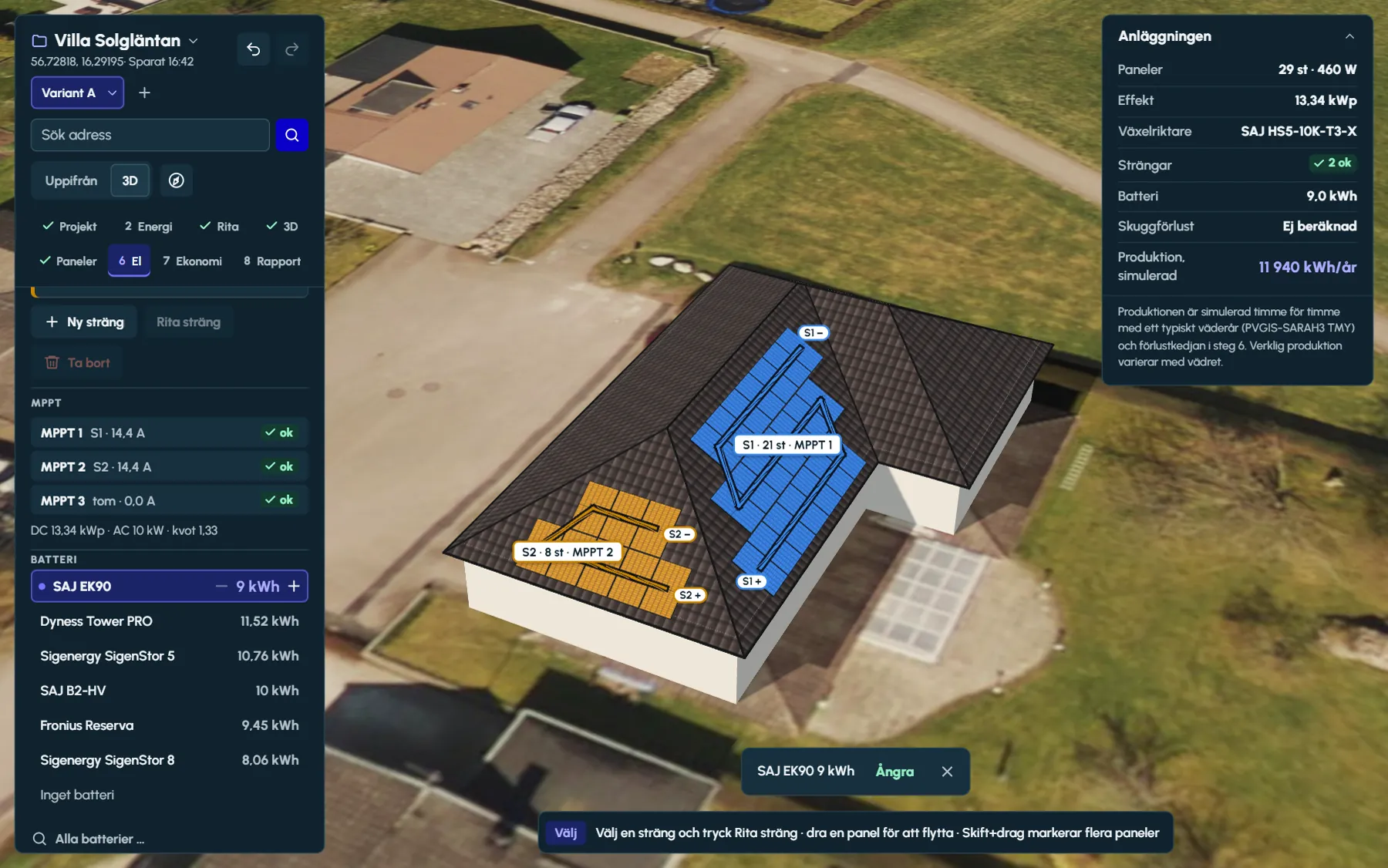
In step 6, Electrics and battery, the designer lists the batteries by name and size in kWh. The list is built on confirmed combinations: if a battery does not work with the chosen inverter, the inverter is swapped for one in the right series when you select the battery, and undo restores both. The whole register is available via All batteries.
Each battery is simulated in every size that fits the inverter’s battery input, hour by hour against the consumption and the roof’s yield. The size shown on the row sits at the knee: the last one before an extra kWh adds less than half of what the first one did. The suggestion is marked with a dot, Suggest selects it, and − and + change the size of the selected battery.
Round-trip efficiency is taken as 92 % and depth of discharge as 90 % when the datasheet does not state the usable capacity.
In different countries
Sweden: the tax reduction for green technology covers 50 % of the labour and material cost of systems for storing self-generated electricity, up to SEK 50,000 per person and year for green technology in total. The battery has to be connected to PV panels that are already in place or installed at the same time, and the reduction is applied on the invoice.
Germany: supply and installation of solar panels, essential components and batteries that store the solar power carry 0 % VAT (§ 12 (3) UStG) when the system is on or near homes or certain public-benefit buildings. The condition is deemed met when the system is no more than 30 kWp according to the Marktstammdatenregister.
Spain: with simplified compensation (compensación simplificada, RD 244/2019), surplus is valued hour by hour, but the compensation over a billing period of at most one month may not exceed the value of the electricity bought. Surplus beyond that earns nothing, and that is where a battery is useful.
Italy: the renovation deduction (Bonus Casa) for 2026 expenditure is 36 %, or 50 % for your own main residence, on at most €96,000 per dwelling according to the Agenzia delle Entrate. ENEA describes the bonus as covering measures for energy saving and renewable energy. Check in the authorities’ guidance that the battery is covered and which documents are required.
Sources
- Skatteverket (Swedish Tax Agency), Grön teknik (storage of self-generated electricity) – checked 14 November 2026
- Umsatzsteuergesetz § 12 Abs. 3 (gesetze-im-internet.de) – checked 14 November 2026
- BOE, Real Decreto 244/2019 on self-consumption, article 14 – checked 14 November 2026
- Agenzia delle Entrate, Agevolazioni per le ristrutturazioni edilizie – checked 14 November 2026
- ENEA, Bonus Casa – checked 14 November 2026
- PVGIS 5.3 PVcalc, Stockholm, monthly yield (35°, south) – checked 14 November 2026
- PVGIS 5.3 PVcalc, Madrid, monthly yield (35°, south) – checked 14 November 2026
Questions and answers
Questions and answers
How big a battery does a house need?
That depends on consumption in the evening and night and on the solar surplus, not on the size of the house. Simulate several sizes against the building’s hourly readings and pick the knee, where the next kWh starts to add clearly less than the first ones.
What is the difference between self-consumption and self-sufficiency?
Self-consumption is the share of the solar yield used in the building. Self-sufficiency is the share of the building’s consumption covered by solar power. With 9,000 kWh of yield, 15,000 kWh of consumption and 3,600 kWh of solar power used, self-consumption is 40 % and self-sufficiency 24 %.
Does it pay to charge the battery from the grid?
Only when the expensive price is higher than the cheap one divided by the battery’s efficiency. With 92 % efficiency, a kWh bought for SEK 1 has to replace electricity that would otherwise cost more than about SEK 1.09, and the wear on the battery has to be covered as well.
Can any battery be connected to the inverter?
The battery has to match the inverter’s battery input in voltage and current, and the manufacturer has to have approved the combination. The number of modules is limited by the voltage window. Check the manufacturer’s compatibility list before you quote.
How do I size for backup power?
Multiply the power of the essential loads by the number of hours they need to run – for example 1.5 kW for 8 hours = 12 kWh usable – and add a margin. The inverter needs a backup function and the installation has to be built for it as the manufacturer specifies.
Read next
- Energy and batteryConsumption profile or hourly readings, PVGIS 5.3, an hour-by-hour simulation and the battery sized against hourly prices.
- EconomicsThe price to the customer on one line, savings per year and payback period – the same figures in the comparison and the PDF.
- String sizing and Voc in the coldThe most and fewest panels per string, worked out step by step with real datasheets.
Try it on a real roof.
The designer opens in your browser, with no account. Search for an address and start drawing.