Solution · Agriculture
The farm’s large roofs, set against the farm’s consumption.
Barns and machinery sheds have long gable roofs, and a farm’s consumption rarely looks like a household’s. That is why the designer calculates against the farm’s own hourly readings.
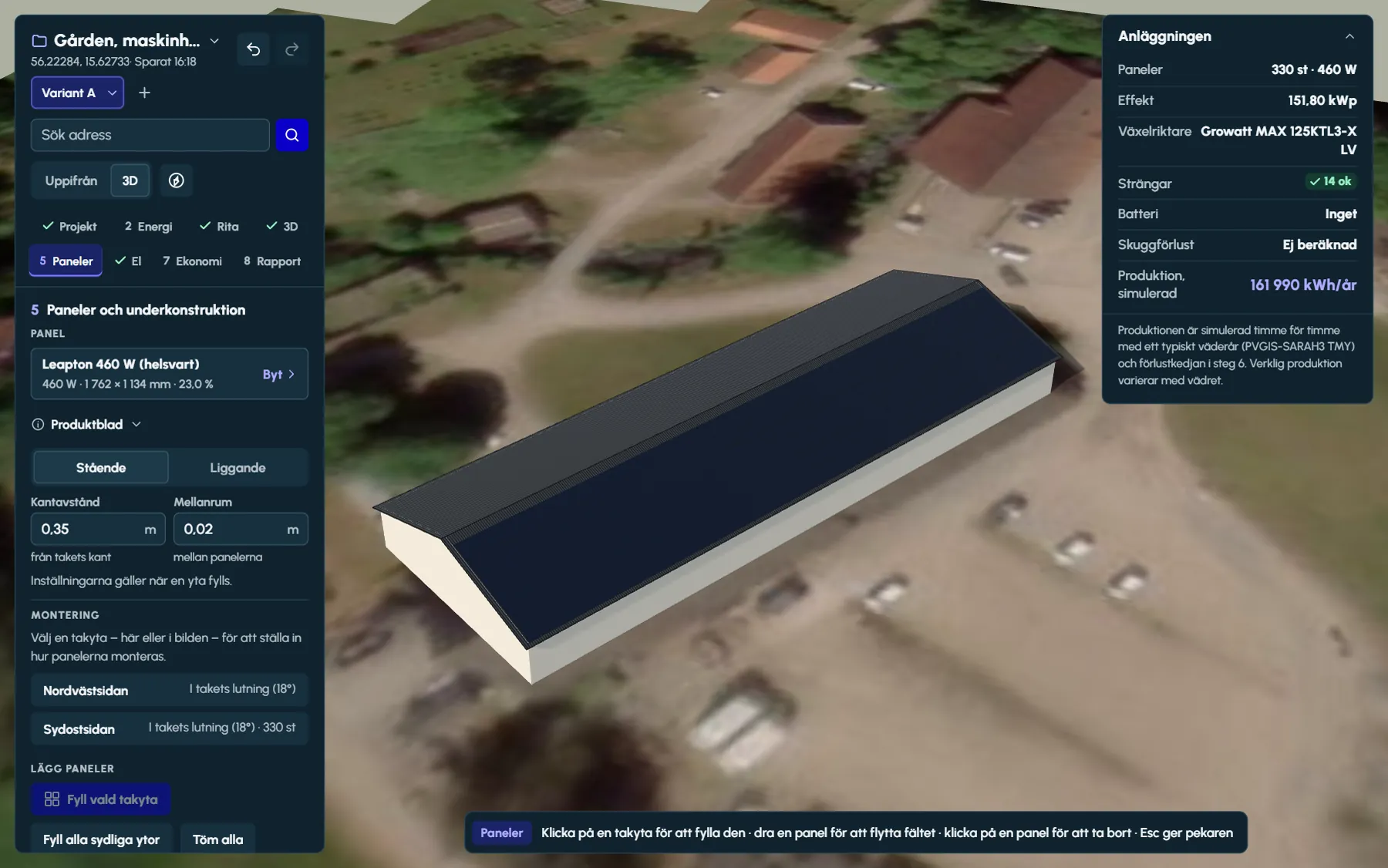
The whole farm in one project
Draw the first building on the aerial photo and continue with Draw next building part: the barn, the machinery shed, the farmhouse or an extension. Each building gets its own roof, its own pitch and its own roofing material.
The roof faces are listed with the building’s name first, so you can see which roof the panels are on. The shading analysis takes every drawn building into account, and trees and poles are added as obstacles that cast shade.
Large gable roofs
A long gable roof is raised with the built-in Gable option, or with Inner edges when the building has an extension. You set the pitch between 0 and 60 degrees, and the ridge is dragged in 3D until the roof matches.
Sheet-metal roofs are common on farm buildings. The register has mounting systems for both standing-seam and trapezoidal sheet metal from Weland and Nordmount, and for clay and concrete tiles on older buildings. Fill a roof face with panels, and the designer keeps the edge distance and the clearance around chimneys and vents.
The farm’s consumption, hour by hour
The designer has profiles for houses, housing associations and businesses, but none for agriculture. A farm with milking, grain drying or cooling has a rhythm of its own, and it only shows in the hourly readings.
Download the hourly readings from the grid operator’s customer portal as CSV and upload the file in step 2. Quarter-hour values are summed to hours, summer time is converted and a file that spans several years gives the latest twelve months. Gaps are filled with the same hour from the week before, and the designer warns you about it.
What is calculated from the hourly readings
- Self-consumption: how much of the solar power the farm uses itself.
- Self-sufficiency: how much of the farm’s consumption the solar power covers.
- Monthly yield against consumption, month by month.
- A typical day in July and in January at the report’s Full level.
- The benefit of a battery, if you add one, simulated for every size.
Compare the roofs as variants
The farm and the consumption are shared, while panels, inverter, battery and mounting belong to the variant. For example, put only the barn’s south-facing slope in one variant and both buildings in the next, and see what each gives.
The comparison shows the variants in columns: system size, annual yield, self-consumption, self-sufficiency, price, savings and payback period. Up to eight variants fit in one project, and the report can show them side by side.
Strings and inverter
The inverter is chosen from the register, with search by power, brand or model. String automatically lays out as few and as long strings as the inverter allows and checks every string against the datasheet: the open-circuit voltage at −25 °C, the operating voltage at 70 °C and the current per input.
Snow loads on large roofs
Enter the ground snow load from Boverket’s Swedish snow map and the reference wind speed for the site. The designer calculates the snow on the roof and the wind pressure to the Swedish BFS 2024:6 with Eurocode, roof face by roof face, and gives the number of fixings per panel and the largest c/c spacing per rail for the chosen system. Other countries’ National Annexes are not applied.
Under More load options you choose the safety class and whether the roof has snow guards, which stop the snow from sliding off and make the shape coefficient at least 0.8. Under BFS 2024:6, chapter 2, §§ 6–7, larger agricultural buildings may be assigned to safety class 2 and smaller ones to safety class 1. The calculation is preliminary and is confirmed in the manufacturer’s calculation before ordering.
Price and payback
If the farm is run as a business, choose Business as the customer type, and the price is calculated excluding VAT. The electricity prices in step 2 are then also entered excluding VAT.
The savings per year are calculated from the yield, the farm’s consumption hour by hour and the electricity prices. The payback period is the price divided by the savings per year. Both are estimates and are presented as such in the report.
Questions and answers
Questions and answers
Is there a consumption profile for agriculture?
No. Ritwerk has profiles for houses, housing associations and businesses. For a farm, the hourly readings from the grid operator give a fairer picture: upload them as CSV in step 2, and self-consumption is calculated on the farm’s actual hours.
Can we draw several buildings on the same farm?
Yes. Draw next building part adds a building to the same project. Each building gets its own roof, pitch and roofing material, and the shading analysis takes all of them into account.
Which mounting systems are there for sheet-metal roofs?
The register has systems for standing-seam and trapezoidal sheet metal from Weland and Nordmount. Choose the roofing material on the building, and the designer shows the systems that fit and puts the fixings in the bill of materials.
Does the designer calculate the snow load on a large gable roof?
Yes. With ground snow load, reference wind speed, terrain and safety class, the designer calculates the load to BFS 2024:6, Sweden’s application rules for the Eurocodes, and gives fixings per panel and the largest c/c spacing. Other countries’ National Annexes are not applied. The number of fixings is confirmed in the manufacturer’s calculation before ordering.
Read next
- Energy and batteryConsumption profile or hourly readings, PVGIS 5.3, an hour-by-hour simulation and the battery sized against hourly prices.
- Mounting and loadsSnow and wind loads to BFS 2024:6: wind zones, fixings per panel and the largest c/c spacing per roof face.
- Snow and wind loads on solar panelsFrom ground snow load and reference wind speed to load per m², wind zones and the c/c spacing of fixings.
- The roof in 3DOutline on aerial imagery, Inner edges and the ridge in 3D – gable, hipped, mansard, flat and your own roof lines.
Try it on a real roof.
The designer opens in your browser, with no account. Search for an address and start drawing.