Guide · Row spacing
Row spacing for ground-mounted systems.
The distance between rows decides how much land a system takes and how much the rows shade each other. Here is how to work it out, with examples for Stockholm, Kassel, Madrid and Rome.
Updated
Four dimensions decide
L is the length of the table along its slope, from front edge to rear edge. β is the tilt of the table. c/c (pitch) is the distance between the front edges of two rows, and the clear gap between rows is c/c minus the horizontal depth of the table, L·cos β.
Land use is often given as GCR (ground coverage ratio): the module area divided by the ground it occupies. For long rows this is L divided by c/c. A GCR of 0.5 means the module area is half the ground area.
On level ground the shadow depends only on the height of the table above its own front edge, L·sin β, and on the position of the sun. How high the whole table stands above the ground does not change the spacing between identical tables, but it does affect snow clearance and access underneath.
Sun elevation at noon
αs = 90° − φ + δ- αs – the sun’s elevation above the horizon when it is due south (12:00 solar time).
- φ – latitude. δ – solar declination: −23.44° at the winter solstice around 21 December, 0° at the equinoxes.
- Example: Stockholm, 59.33° N: 90 − 59.33 − 23.44 = 7.2°.
Unshaded row spacing
c/c = L · cos β + L · sin β · cos γs / tan αs GCR = L / (c/c)- L · cos β – the horizontal depth of the table.
- L · sin β · cos γs / tan αs – how far the shadow reaches behind the table, measured at right angles to the rows.
- γs – the solar azimuth measured from south at the chosen time. At noon the sun is due south, γs = 0 and cos γs = 1. Before and after noon the sun is lower, so the shadow is longer, but it falls obliquely across the rows. Only the part of the shadow at right angles to the rows counts towards the next row, and that is what the factor cos γs gives.
- The formula applies to rows running east–west on level ground. Ground sloping to the north needs a longer c/c, ground sloping to the south a shorter one.
Worked example: 4.0 m table at 25°, unshaded at noon on 21 December
- Height of the table above its front edge, 4.0 · sin 25°
- 1.69 m
- Horizontal depth of the table, 4.0 · cos 25°
- 3.63 m
- Stockholm, 59.33° N: αs 7.2°, shadow 13.33 m
- c/c 16.95 m · GCR 0.24
- Kassel, 51.31° N: αs 15.3°, shadow 6.20 m
- c/c 9.83 m · GCR 0.41
- Madrid, 40.42° N: αs 26.1°, shadow 3.44 m
- c/c 7.07 m · GCR 0.57
- Rome, 41.89° N: αs 24.7°, shadow 3.68 m
- c/c 7.31 m · GCR 0.55
The same table needs more than twice the c/c in Stockholm as in Madrid. The shadow grows quickly when the sun is low: halve the sun’s elevation and the shadow more than doubles in length.
A stricter criterion: unshaded from 10:00 to 14:00 solar time at the winter solstice
| Location | Sun elevation at 10:00 | Solar azimuth from south | c/c | GCR |
|---|---|---|---|---|
| Stockholm | 3.6° | 27.4° | 27.35 m | 0.15 |
| Kassel | 10.7° | 27.8° | 11.51 m | 0.35 |
| Madrid | 20.3° | 29.3° | 7.61 m | 0.53 |
| Rome | 19.0° | 29.0° | 7.91 m | 0.51 |
Same table, 4.0 m at 25°. Sun position at 10:00 solar time (hour angle 30° before noon) calculated with δ = −23.44°. At 14:00 the position is mirrored and gives the same c/c.
Yield against area
Requiring unshaded rows at the winter solstice makes sense in southern Europe but costs a lot of land in the north. Winter also carries different weight. With a south-facing panel at 25°, November–January gives 4.3% of annual yield in Stockholm according to PVGIS, 8.4% in Kassel, 15.7% in Rome and 17.6% in Madrid. December alone is 1.0% in Stockholm and 5.7% in Madrid.
In the north, winter shading therefore costs few kWh, and a tighter pitch than the unshaded one can give more energy per hectare. In Spain and Italy, shade around midday costs a larger part of the year. Where the line falls depends on the price of land, the capacity of the grid connection and what the shading costs in kWh – and the last of these is worked out with an hourly shading simulation.
A lower tilt gives a shorter row spacing
| Location | Optimum tilt (PVGIS) | kWh/kWp at optimum tilt | kWh/kWp at 25° | Unshaded c/c at optimum tilt | Unshaded c/c at 25° |
|---|---|---|---|---|---|
| Stockholm | 44° | 989 | 950 (−3.9%) | 24.78 m | 16.95 m |
| Kassel | 38° | 1,017 | 998 (−1.9%) | 12.18 m | 9.83 m |
| Madrid | 37° | 1,620 | 1,592 (−1.7%) | 8.10 m | 7.07 m |
| Rome | 36° | 1,499 | 1,476 (−1.5%) | 8.35 m | 7.31 m |
PVGIS 5.3 (SARAH3, 14% system losses), south-facing, a single row standing alone with no shading from other rows, calculated on 14 November 2026. c/c for a table 4.0 m along the slope, unshaded at noon on 21 December. Yield is an estimate.
The trade-off in figures
Lowering the tilt from the optimum to 25° costs 1.5–3.9% per kWp in a stand-alone row but shortens the unshaded row spacing by 13–32%. More kWp fit on the same land, and each row casts less shade. A shallower tilt therefore gives more energy per hectare in exchange for a small loss per panel.
The same formulas apply to rows on flat roofs, using the depth of the panel instead of the table. There the roof area is fixed and the clear gap between rows is often small. That is why south-facing rows on flat roofs are compared with east–west systems, which have a guide of their own.
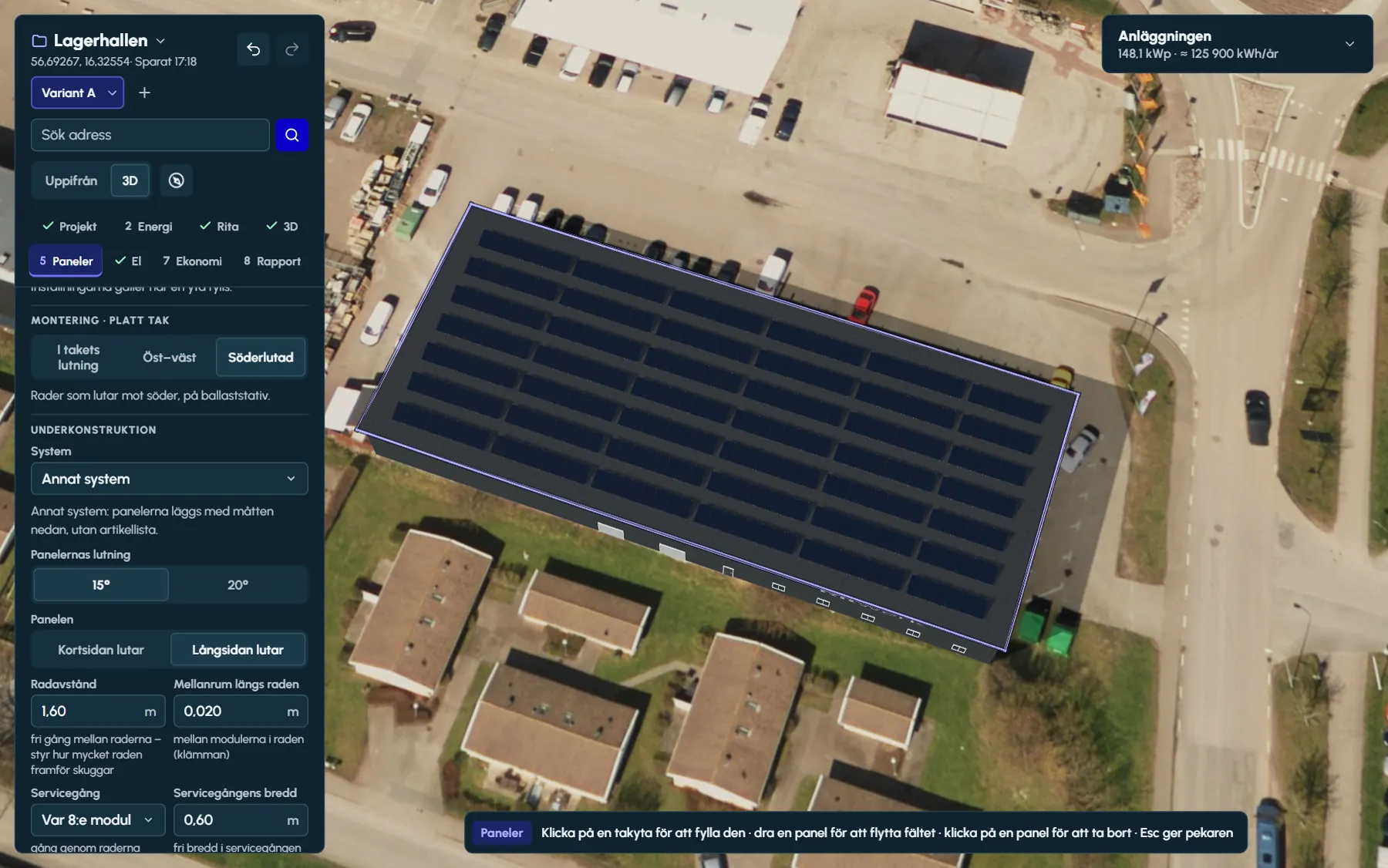
In Ritwerk you set the row spacing for south-facing rows on flat roofs in metres, and the designer shows the c/c between the rows. The rows shade each other in the shading analysis, so the effect of a shorter spacing shows panel by panel.
In different countries
Sweden. Latitude makes row spacing the big question. At noon on the winter solstice the sun stands 7.2° above the horizon in Stockholm, and in Kiruna (67.9° N) it stays below the horizon all day. There the criterion has to be set for another date, or the winter shading accepted. The optimum tilt from PVGIS for Stockholm is 44°.
Germany. In Kassel the sun stands at 15.3° at noon on 21 December, and the optimum tilt from PVGIS is 38°. EEG § 37 Abs. 1 Nr. 2 sets out where ground-mounted systems can receive support in the EEG auctions – among them already sealed surfaces, conversion areas, a strip of up to 500 m along motorways and railways measured from the outer edge of the carriageway, and arable land or grassland in disadvantaged areas.
Spain. In Madrid the sun stands at 26.1° at noon on the winter solstice, and November–January gives 17.6% of annual yield, so winter shading costs more than in the north. Under Ley 21/2013 (Annex I, group 3 j), PV installations that are not on roofs and occupy more than 100 ha require an ordinary environmental assessment. Smaller ground-mounted systems may fall under the simplified assessment in Annex II, group 4 j.
Italy. In Rome the sun stands at 24.7° at noon on the winter solstice, and the optimum tilt from PVGIS is 36°. DL 63/2024 (art. 5, converted by Law 101/2024) restricted PV with ground-mounted modules in areas classified as agricultural to certain areas and put the rule in art. 20 of d.lgs. 199/2021. That article has since been repealed, and the rule in force is now in art. 11-bis(2) of d.lgs. 190/2024: permitted areas include disused quarries and mines and closed landfills, with exceptions for renewable energy communities and PNRR projects. The rule has changed several times, so check the version in force on Normattiva before a project.
Sources
- PVEducation: Elevation Angle – checked 14 November 2026
- PVEducation: Declination Angle – checked 14 November 2026
- NREL: PVWatts Version 5 Manual (definition of ground coverage ratio) – checked 14 November 2026
- pvlib: infinite_sheds.get_irradiance (GCR = row length along the slope / row pitch) – checked 14 November 2026
- European Commission (JRC): PVGIS 5.3 – checked 14 November 2026
- Gesetze im Internet: EEG § 37 – checked 14 November 2026
- BOE: Ley 21/2013 de evaluación ambiental, consolidated text – checked 14 November 2026
- Normattiva: DL 15 maggio 2024, n. 63, art. 5 – checked 14 November 2026
- Normattiva: d.lgs. 8 November 2021 no. 199, art. 20 (repealed) – checked 14 November 2026
- Normattiva: d.lgs. 25 November 2024 no. 190, art. 11-bis – checked 14 November 2026
Questions and answers
Questions and answers
What GCR is reasonable?
It depends on latitude, tilt and the price of land. A table 4.0 m along the slope at 25° gets a GCR of 0.24 in Stockholm and 0.57 in Madrid if it is to be unshaded at noon on the winter solstice. Pack the rows tighter and GCR rises, along with winter shading.
Should the rows be unshaded at the winter solstice?
It is worth more where winter makes up a large share of annual yield: November–January accounts for 17.6% in Madrid according to PVGIS. In Stockholm the share is 4.3%, and an unshaded pitch there costs a lot of land for little energy.
Does the height of the table above the ground affect row spacing?
Not between identical tables on level ground. The shadow is set by the height of the table above its own front edge, L·sin β, and by the position of the sun. Height above ground affects snow clearance, vegetation and access underneath the tables.
How much do I lose with a lower tilt?
According to PVGIS, 25° instead of the optimum tilt gives 1.5–3.9% less per kWp in a stand-alone row in Stockholm, Kassel, Madrid and Rome. At the same time, the unshaded row spacing becomes 13–32% shorter.
Does the formula also apply to rows on flat roofs?
Yes, using the depth and height of the panel instead of the table. In Ritwerk you set the row spacing for south-facing rows on flat roofs, and the shading analysis calculates how the rows shade each other.
Read next
- Panels and mounting systems per roof facePanel arrays per roof face, flush, east–west or south-facing, with mounting system and bill of materials.
- Shading analysis per panelSun path, sky view and shading loss per panel – with dormers, chimneys, trees and walls.
- East–west or south on flat roofsMore kWp per m² or more kWh per kWp – the comparison with figures for four locations, ballast, walkways and fire safety.
- Shading losses on solar panelsNear shading, horizon and rows – and why a partly shaded panel loses more than its share.
Try it on a real roof.
The designer opens in your browser, with no account. Search for an address and start drawing.